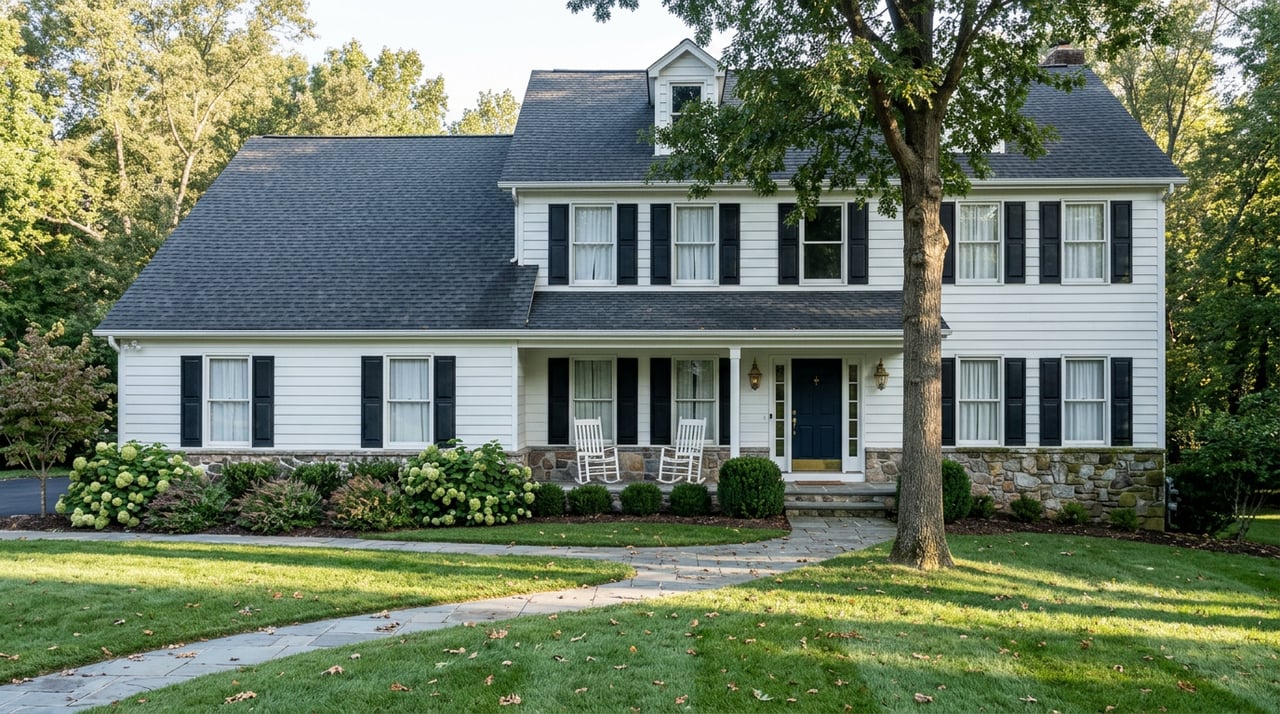
Drive Highway 1 through Moncure and you will pass the reason half of North Carolina spent 2022 talking about Chatham County. The land is graded. The trees are gone. What's left, according to one recent account of the site, is a cleared parcel tied to a $450 million project now the subject of a lawsuit. Fifteen minutes north, on the other side of the county, cranes are still up at Chatham Park, David Weekley Homes is selling paired villas in a section called Encore, and a new Italian restaurant is getting ready to open its doors at Mosaic.
Those two scenes are the same county, the same year, and almost the same news cycle. They are not, however, the same story, and if you are trying to figure out what's actually happening to Chatham County real estate right now, that distinction is the whole answer.
The VinFast Lawsuit and Land Listings Near Moncure
In November 2022, VinFast signed an agreement with North Carolina that promised a $4 billion electric vehicle plant and roughly 7,500 jobs on a nearly 2,000-acre site near Moncure. The state agreed to put up to $450 million toward site prep, roads, water, and sewer. VinFast agreed to specific deadlines in return: vertical construction on buildings had to start by January 1, 2024, and the plant had to be operating with 1,750 workers by the end of 2026.
The construction deadline was missed. VinFast cleared and graded the land in 2023, then stopped work entirely in December 2024. In January 2026, North Carolina's Department of Justice notified the company it had defaulted. VinFast pushed back in March, submitting scaled-down permit requests that cut the promised workforce to around 1,400. It wasn't enough. On May 21, 2026, Attorney General Jeff Jackson filed suit in Wake County Superior Court to reclaim the site on the state's behalf, arguing VinFast had made "zero progress toward the construction of any buildings or structures." Governor Josh Stein framed the move as getting the megasite "back on the market" for a company that would actually build something.
The case is still open. Attorneys for both sides filed an extension in late July, and VinFast's response to the amended complaint was due September 2, 2026. Separately, on July 27, 2026, the Chatham County Board of Commissioners voted to terminate the county's own economic development agreement with VinFast, citing the company's failure to hit the benchmarks tied to $400 million in future local incentives. According to the state's own filing, VinFast had spent $301.2 million on the project as of the end of last year and still has nothing built above ground.
Here's the shape of it, laid out in order:
| Date | What happened |
|---|---|
| November 2022 | State signs agreement with VinFast: $4B investment, 7,500 jobs, deadlines attached |
| 2023 | Site cleared and graded near Moncure |
| December 2024 | VinFast halts all work on the site |
| January 6, 2026 | NC Department of Justice sends formal default notice |
| March 2026 | VinFast submits scaled-back permit request, cuts job estimate to ~1,400 |
| May 21, 2026 | Attorney General Jeff Jackson files suit to reclaim the site |
| July 27, 2026 | Chatham County terminates its own economic development agreement with VinFast |
| September 2, 2026 | VinFast's court-ordered deadline to respond |
If you've seen a land listing near Moncure or Siler City in the last year, there's a decent chance it mentioned VinFast or Wolfspeed as a selling point. One active acreage listing in the corridor pitches itself as being "minutes from Wolfspeed's $5 Billion investment," and it's far from the only one leaning on that language. It was written when the industrial story still looked like a sure thing. Right now, one half of that story is sitting in a Wake County courtroom.
Wolfspeed Is a Different Case, and That Matters
It would be a mistake to fold Wolfspeed into the same narrative. The Siler City facility has over 2 million square feet under roof, a tax value exceeding $300 million, more than $700 million in CHIPS Act funding already secured, and a recently announced manufacturing partnership with Toyota. That's a real, physically built plant with federal money behind it, not a graded field.
It's also not a guarantee. Local coverage has described Wolfspeed as remaining "a symbol of both opportunity and uncertainty" for the western half of the county, and no one closely following either project treats Wolfspeed's long-term staffing targets as settled. The point isn't that industrial recruitment in Chatham County is fake. It's that VinFast and Wolfspeed are two different bets with two different risk profiles, and land priced as if they were interchangeable is being priced wrong.
The Development That Isn't Waiting on Either Factory
Meanwhile, on the Pittsboro side of the county, none of this legal drama has slowed anything down.
Chatham Park, the 8,500-acre master-planned community developed by Preston Development Company, is still moving through its build-out toward a planned 27,000 residential units and more than 22 million square feet of commercial and research space. The Pittsboro Board of Commissioners approved South Village, a new 5,000-acre section east of downtown, in a 3-2 vote. That section joins existing Chatham Park neighborhoods like The Vineyards, Tessera at Mosaic, and NoVi, and it's designed to include its own research and development space alongside housing.
Disney's Storyliving community, Asteria, is doing the same thing on its own separate timeline. Announced in 2023 as a roughly 1,500 to 1,550-acre section within Chatham Park, Asteria broke ground in 2025, is expected to start home sales around 2027, and should see its first residents move in around 2028. It includes a planned 55-plus neighborhood built by Del Webb, which is marketing its own Chatham Park community with ranch floor plans and a 20,000-square-foot clubhouse, listing its proximity not to any factory but to Mosaic, downtown Pittsboro, and Fearrington Village.
North of town, a Chapel Hill-based development group called Hamlets Reserve, tied to the Bold Companies, closed on 109 acres off Hamlets Chapel Hill Road for a little over $2.4 million and is building homes there that will sell for more than $1 million, with delivery expected this year. The land sits north of Pittsboro, across Highway 501 from Fearrington, nowhere near either megasite.
At Mosaic, the 44-acre retail gateway to Chatham Park, the tenant roster keeps filling in. The Root Cellar, House of Hops, and Marco's Pizza are already open at the Penguin Place retail building near the entrance, and a Tavolo, a wood-fired Italian restaurant, was slated to open in the development this summer. None of that leasing activity has anything to do with whether a car ever comes off a line in Moncure.
What Your Land Dollar Is Actually Pricing
This is where the numbers stop being abstract and start telling you something.
As of spring 2026, Chatham County's median home price sat near $665,000, the highest in the Triangle region, with inventory up roughly 18 percent year over year and homes averaging 28 to 35 days on market. A separate estimate from the county's economic development briefing put new construction averaging closer to $900,000 countywide. Those numbers describe a market still absorbing demand at a healthy clip, not one whose outlook depends on the VinFast factory project.
Raw acreage tells a more complicated story. Land listings around Pittsboro average roughly $138,000 per acre, but that average blends two very different products. One is speculative acreage in the industrial corridor, priced with language that leans on VinFast and Wolfspeed's proximity even as one of those projects sits in litigation. The other is land already inside, or immediately adjacent to, Chatham Park's approved master plan, where pricing tracks the development's own build-out schedule, its retail absorption at Mosaic, and its distance to Raleigh-Durham, not a manufacturing announcement.
Those are two different bets wearing the same price-per-acre label. A parcel near Moncure carries genuine upside if the site gets a new tenant, and genuine downside if it doesn't for years. A lot inside Chatham Park's approved sections is pricing off a plan the town has already voted on, a builder lineup that's already selling, and a commute to the Triangle that doesn't depend on anyone's earnings call.
What This Means If You're Looking at Land or a Lot Right Now
If you're evaluating a parcel or a new construction lot in Chatham County this fall, the question worth asking isn't "is this near the growth." It's "which growth is this actually near, and has it been approved by anyone other than a press release."
Land inside Chatham Park's boundaries, including South Village and the sections building out around Asteria, is tied to zoning and infrastructure decisions the Pittsboro Board of Commissioners has already made. Land marketed primarily on its proximity to Wolfspeed or the former VinFast site is tied to two industrial projects with very different levels of certainty behind them; one remains the subject of active litigation, and VinFast's response to the amended complaint was due September 2, 2026.
Both can be reasonable purchases. They are not the same purchase, and the distinction is worth considering when evaluating a parcel.
If you're weighing land, a custom build, or a move into Chatham County against options elsewhere in the Triangle, Capital to the Coast works construction and land transactions across this market regularly and can walk through what a specific parcel's pricing is actually built on before you commit to it. Reach out for a conversation about what your money would be buying, not just what it's being advertised as buying.
Quick Questions
Does the VinFast lawsuit affect home values inside Chatham Park? Not directly. Chatham Park's approvals, builders, and retail leasing at Mosaic have continued on their own schedule throughout the litigation, and the county's spring 2026 median price reflects that continued demand.
Is Wolfspeed at risk of the same kind of buyback? Nothing in current reporting suggests that. Wolfspeed has a physically built facility, secured CHIPS Act funding, and a new manufacturing partnership with Toyota, which puts it in a different position than a site that never broke ground.
What happens to the Moncure site if the state wins? North Carolina has said its goal is to remarket the roughly 2,000-acre site to a new manufacturer rather than convert it to residential use, so the most likely outcome is a different industrial tenant, not a housing development.
This article is general information, not legal, tax or financial advice. Consult a qualified professional about your situation.